Older properties often have outdated wiring that's no longer safe or adequate for modern electrical demands. Our rewiring service brings your property up to current standards, improving safety and capacity. We also install wiring for extensions, loft conversions, and new builds.
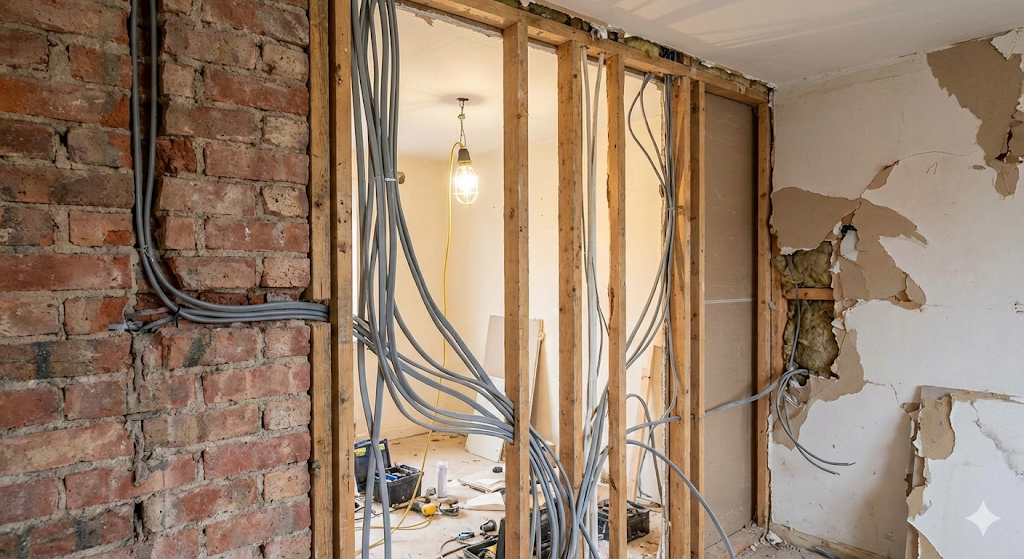
Rewiring brings a property's electrical installation up to the current safety standard, BS 7671. It's some of the most disruptive but important work an electrician carries out, and the signs a home needs it are usually clear: round-pin sockets, fabric or rubber-sheathed cabling, a rubber-insulated supply, an old wooden or cast-iron fuse box, frequent blown fuses, scorch marks, or simply too few sockets for how the household lives today. Many homes around Haverhill and the wider Suffolk area are either period properties or post-war housing, and installations from those eras often haven't been touched in decades. A full rewire replaces all the cabling, sockets, switches and the consumer unit; a partial rewire tackles a single floor, a kitchen, or circuits that have aged badly while sound sections are left in place.
A typical rewire involves a first fix (running new cables, often chasing into walls and lifting floorboards) and a second fix (fitting accessories, the consumer unit and final connections), followed by testing and certification. In period and listed homes the work is handled sensitively, planning cable routes to limit chasing, working with existing voids where possible, and making good as we go to protect original features. We also wire extensions, loft conversions and renovations to the same standard, integrating new circuits with the existing installation.
As a NAPIT-registered electrician, all work meets Part P of the Building Regulations and is fully certified, giving you the Electrical Installation Certificate you'll need for insurance, sale or letting. Harry Crane will survey the property and explain exactly what's needed before any work begins.
The clearest signs are old round-pin sockets, fabric-covered or rubber-insulated cabling, and an old-style fuse box with rewireable fuses rather than circuit breakers. Other warning signs include frequent blown fuses or tripping, flickering lights, a burning smell near sockets or switches, discoloured or warm faceplates, and far too few sockets for modern use. Wiring more than around 25 to 30 years old is often nearing the end of its safe life. The only reliable way to be sure is an inspection, so we offer a free survey of your property and will tell you honestly whether a full rewire, a partial rewire, or simple remedial work is needed — and if you've had quotes elsewhere for house rewires, we're happy to talk through what's actually involved before you commit.
A full rewire replaces all the cabling, sockets, switches, light fittings and the consumer unit throughout the property. It is carried out in two stages. The first fix involves running new cables, which usually means chasing channels into walls and lifting floorboards to reach the routes. The second fix is fitting the accessories, connecting everything to a new consumer unit and powering up. The installation is then tested and certified to BS 7671. We work room by room to keep as much of the house usable as possible, and we make good as we progress so you are left with a safe, modern installation and proper certification.
A full rewire of a typical three-bedroom home usually takes in the region of five to ten working days, though the exact time depends on the size of the property, how easy the cable routes are to access, the amount of making good required, and whether you want extra sockets or new lighting added. Larger or period homes, and those with solid floors or limited access, naturally take longer. Partial rewires are much quicker. We will give you a realistic timescale after surveying the property, and we plan the work to keep disruption to a minimum, generally working room by room rather than shutting the whole house down at once.
Some disturbance is unavoidable, because new cables need to be chased into walls and run beneath floors. However, we plan routes carefully to keep this to a minimum and we make good as we go, filling chases ready for redecoration. In period and listed homes we take particular care, using existing voids, conduit and discreet routes wherever possible to protect original plasterwork, beams and features, and minimising any visible damage. We will always explain what making good is included before starting. Bear in mind that final decoration, such as repainting or re-plastering to a finish, is usually arranged separately so you can match it to the rest of the room.
There is no single figure, because the cost of a rewire depends on several factors: the size of the property and number of rooms, how accessible the cable routes are, the condition of the existing installation, whether it is a full or partial rewire, and the standard of finish and making good you want. Period and listed homes that need sensitive working can differ again from a straightforward post-war house. The fairest way to get an accurate price is a proper look at the property, so we provide a free, no-obligation survey and a clear written quote with no hidden extras. Just call Harry on 07814 523401 to arrange a visit.
Modern consumer unit upgrades, fuse board replacements, and electrical panel repairs for improved safety.
Professional installation, relocation, and repair of electrical sockets and switches throughout your home or business.
Electrical Installation Condition Reports (EICR) for landlords, homeowners, and businesses.
Every rewiring & electrical wiring job is carried out by Harry Crane, HC Electrical's NAPIT-registered electrician. See his credentials and how a job runs from quote to completion.
We provide rewiring & electrical wiring for homes and businesses throughout Haverhill and the surrounding towns: